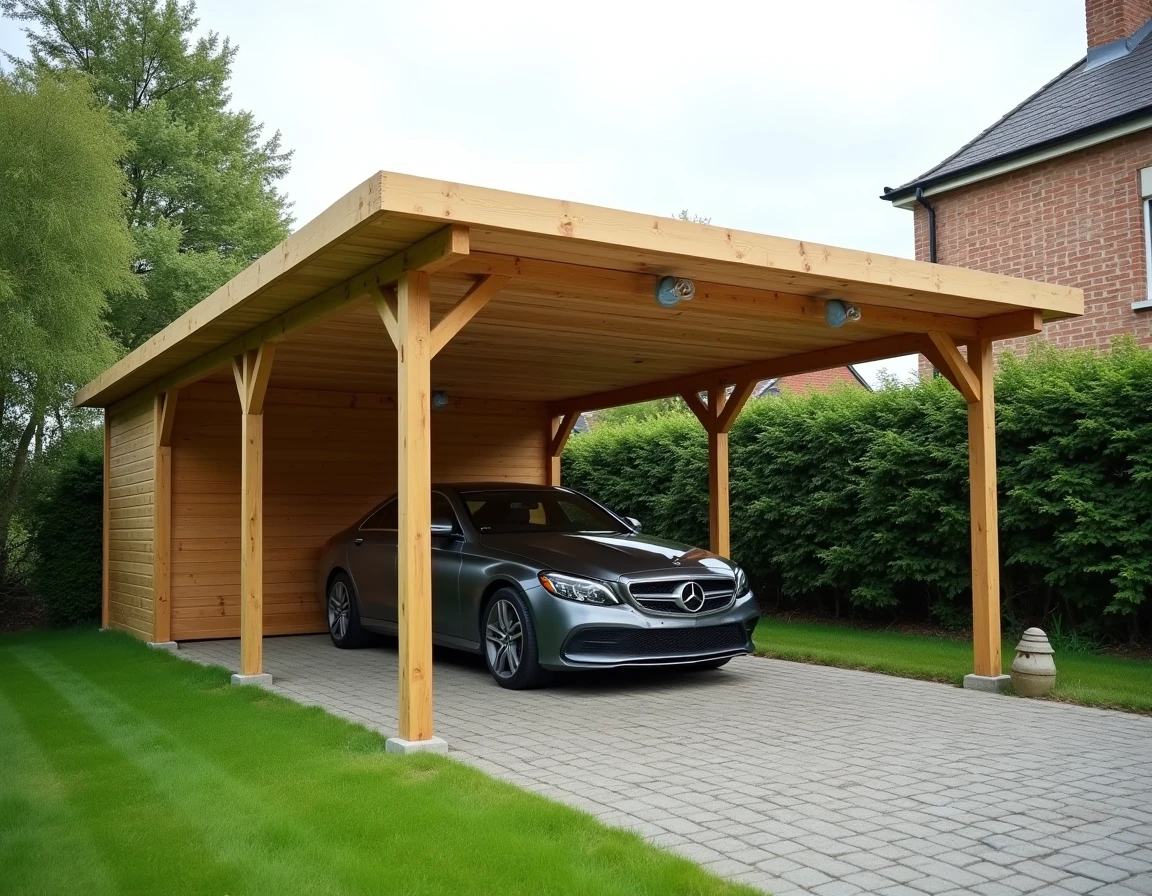
A gently sloping plot, a gravel driveway that cannot support a concrete slab, and a car that spends every night outside in the rain: this is often the scenario that leads to considering a wooden carport kit. Unlike a masonry garage, this open structure adapts to the constraints of the existing ground and can be assembled in a weekend with two pairs of hands, without a building permit in most cases.
Ground anchoring and nature of the terrain: the real starting point for a wooden carport
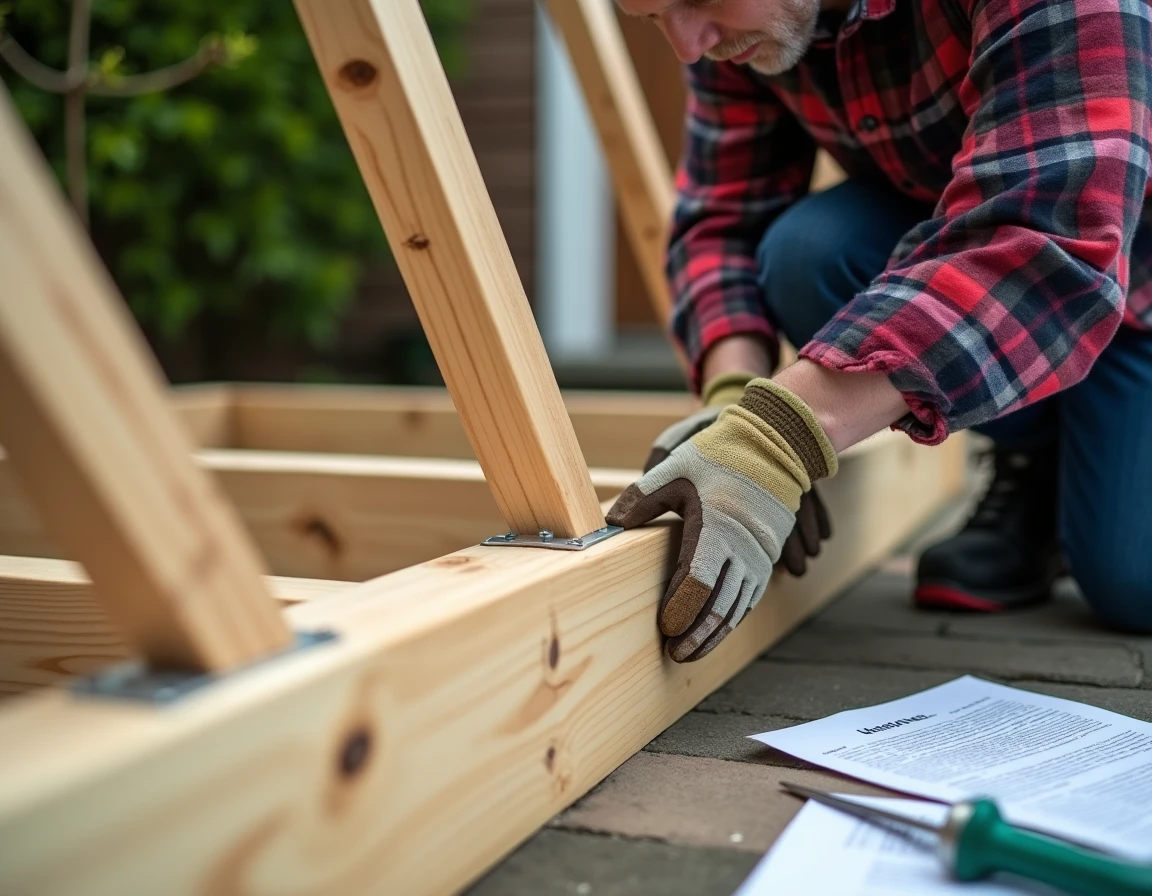
We rarely start by choosing the type of wood or the shape of the roof. The first instinct is to look at the ground. A kit carport delivered with mounting plates assumes a solid support (slab, concrete blocks, foundation footings). On bare earth or loose gravel, it is necessary to pour concrete footings buried to the frost depth of your region.
The frost depth varies according to climatic zones. In flat areas, it is around a few tens of centimeters, but in mountainous areas, the returns vary on this point, often exceeding double. Check with your town hall, which has this data in the local urban planning plan.
A standard kit generally includes four to six posts with metal brackets. Ensure that the brackets are made of galvanized steel, not raw steel: rust attacks within a few months when in contact with damp concrete. This is a detail that product sheets do not always highlight, including on models of wooden carport kits at Brico Dépôt, where the quality of the hardware depends on the chosen range.
Wooden carport kit: what the package really contains
The word “kit” suggests an assembly like a Swedish furniture piece. The reality is more raw. You receive posts, beams, rafters, fasteners, and an assembly plan. There is neither roof covering nor side cladding in most entry-level kits.
Here’s what you find in a standard package and what you need to plan for additionally:
- The kit itself contains the load-bearing structure (posts, crossbeams, rafters), anchoring brackets, and bolts, sometimes a temporary roof tarp.
- The roof covering (bituminous sheets, polycarbonate, or tiles) is almost always sold separately. Expect a significant additional cost, especially if you opt for translucent sheets that let in light.
- Finishing accessories (gutters, post base covers, reinforced brackets) are not included in the basic package. They are purchased separately, and they represent a line item that is systematically forgotten in the initial budget.
The displayed price of a kit never covers the entire project. Allow for a margin for the covering, concrete anchoring, and additional hardware. It is this “invisible” item that generates the most disappointments after purchase.
Type of wood and autoclave treatment: choose according to your climate
The kits sold in DIY superstores mainly use treated pine or spruce. The autoclave treatment injects a fungicide under pressure into the wood, protecting it against fungi and wood-eating insects. For a carport exposed to the elements, wood classified at least in class 3 for use is recommended (outdoor use without direct contact with the ground).
Douglas fir, naturally resistant to moisture, is a more durable but more expensive alternative. It is mainly found with specialized manufacturers. Its advantage: it grays over time without degrading and requires no chemical treatment if you accept the change in color.
Real maintenance in the first years
A treated pine carport requires a coat of stain or saturator within the first two years, then a refresh every three to five years depending on exposure. Without this maintenance, the wood does not immediately rot thanks to the treatment, but it will crack and gradually lose its mechanical strength.
An untreated Douglas ages better than a poorly maintained treated pine. If you know in advance that you will never apply stain, consider Douglas or larch, even if it means investing more at the time of purchase.
Prior declaration of work: surface threshold and local rules
For a carport with a footprint of less than twenty square meters, a simple prior declaration of work is sufficient in most municipalities. Beyond this threshold, a building permit becomes mandatory. In protected areas (surrounding a historic monument, classified site), the rules become stricter regardless of the format.
The prior declaration is submitted to the town hall and the processing time is generally one month. Be sure to check the distances for placement relative to the property lines: most local urban plans impose a minimum setback, often a few meters.
Development tax and carport
A carport is subject to the development tax as soon as it creates taxable surface area. The amount depends on the municipality and department. This cost, rarely anticipated when purchasing the kit, can represent a significant sum. Inquire before submitting your application to avoid an unpleasant surprise upon receiving the notice.
Wooden carport and property value enhancement
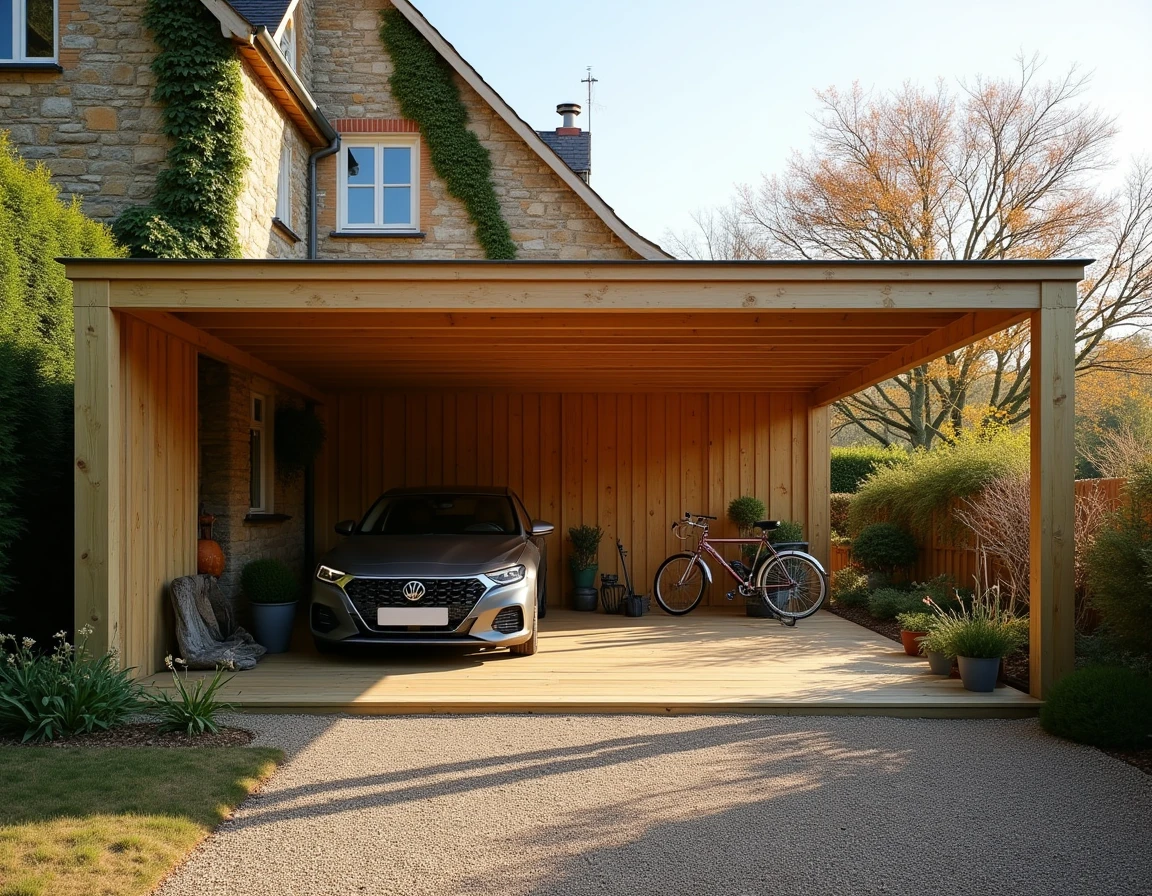
Notaries and real estate agents observe that a house equipped with a carport properly integrated into the building attracts significantly more visits than a similar property without a car shelter. The perceived added value strongly depends on the architectural integration: a carport placed without coherence with the facade does not have the same effect as a structure whose roof slope, wood color, and alignment visually extend the house.
The current trend leans towards large-format wooden carports, designed to accommodate a vehicle but also a storage space or an adjoining workshop. This type of mixed structure, freestanding or attached, appeals to both individuals and micro-entrepreneurs looking for a functional shelter without building a closed structure.
A wooden carport kit remains the most accessible option to protect a vehicle without heavy work. The success of the project depends less on the choice of model than on the preparation of the ground, the actual budget (kit plus covering plus anchoring), and compliance with urban planning formalities. Three items to validate before placing an order, not after.