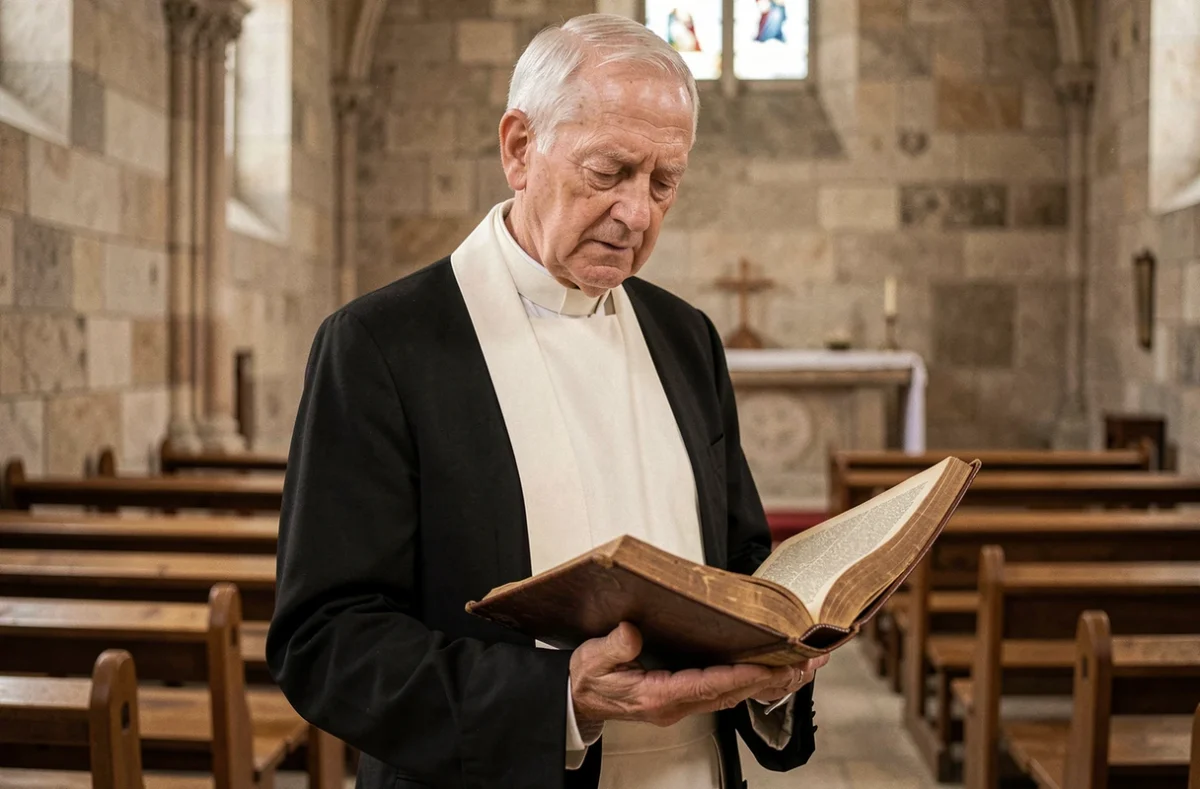
The exorcism of Leo XIII actually refers to two distinct texts, often confused in devotional literature. The brief prayer to Saint Michael the Archangel, recited after low mass, and the Exorcismus in Satanam et angelos apostaticos, a developed rite published in the Roman Ritual of 1903, do not have the same structure, usage context, or canonical conditions for recitation.
Canon 1172 and canonical conditions of solemn exorcism
Cannon law draws a clear line between personal prayer and reserved liturgical acts. The canon 1172 of the Code of Canon Law reserves solemn exorcism to a priest who has obtained express permission from the local ordinary. Any formula that directly addresses Satan falls under this framework and cannot be presented as a deliverance prayer accessible to any faithful person.
This distinction has practical consequences. A layperson can recite the brief prayer to Saint Michael without restriction, as it is a supplication addressed to the archangel, not a command directed against the demon. The great exorcism, on the other hand, contains direct injunctions (“we command you”, “therefore, retreat, Satan”) that place the officiant in a position of spiritual authority framed by an ecclesial mandate.
We observe that the confusion between these two registers persists in many online publications, which reproduce the full text of the great exorcism without mentioning this canonical restriction. This omission poses a pastoral as well as a legal problem.
Brief prayer to Saint Michael and Leonine prayers: two texts to distinguish
Leo XIII extended the prayers after low mass to the entire Church in 1884. The invocation to Saint Michael the Archangel was added in 1886. These Leonine prayers included three Hail Marys, a Salve Regina, a collect, and the prayer to Saint Michael.
Finding the text of the exorcism of Leo XIII in its French version allows one to measure the gap between the brief prayer and the complete rite. The former consists of a few lines and asks for the archangel’s intercession. The latter spans several pages, includes Psalms 67 and 34, a developed supplication, and formulas of adjuration.
The recitation of the Leonine prayers after mass ended with the entry into force of the instruction Inter Oecumenici on March 7, 1965. Since that date, they are no longer prescribed within the liturgical framework, although their private use remains permitted.
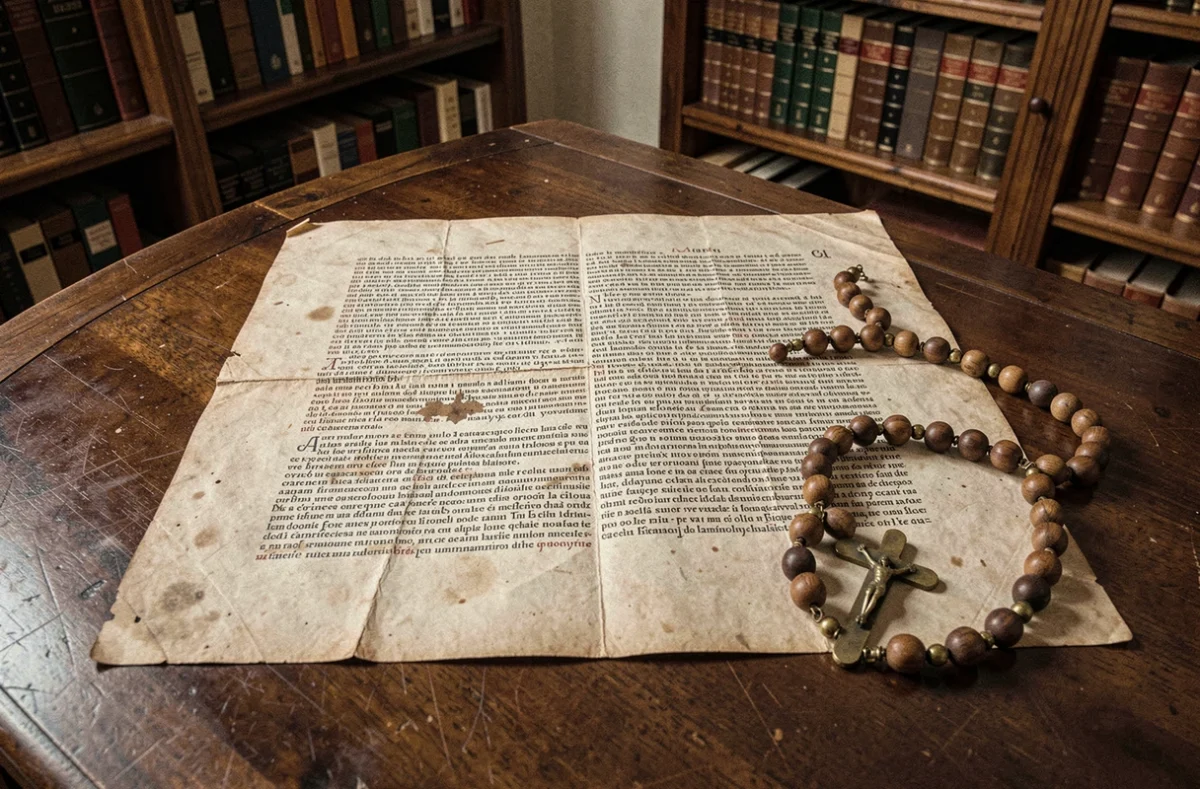
Liturgy structure of the great exorcism of Leo XIII
The complete rite follows a precise arrangement that reflects the theology of spiritual combat characteristic of the late 19th century.
- Opening with Psalm 67 (“Let God arise and let His enemies be scattered”), which sets the framework of divine power against opposing forces.
- Psalm 34 (Vulgate numbering), a personal protection prayer of the celebrant against those who “meditate his misfortune”.
- Supplication to Saint Michael the Archangel, the central passage where the celebrant invokes the “most glorious prince of the heavenly armies” as guardian and protector of the Church.
- Formulas of direct adjuration against Satan, reserved for the mandated priest, which constitute the exorcistic part of the rite.
This architecture is not arbitrary. The psalms precede the adjuration to establish divine authority before the officiant directly addresses the evil spirit. The supplication to Saint Michael serves as a pivot between praise and command.
Theology of the text: intercession and authority
The great exorcism articulates two theological registers. The first pertains to intercession: the celebrant prays to God and Saint Michael to intervene. The second pertains to delegated authority: “In the name of Jesus Christ, our God and Lord,” the priest commands the demon to retreat.
This dual register distinguishes the Leonine rite from a simple prayer of protection. The solemn exorcism engages the sacramental authority of the priest, not just his personal faith. This is why the bishop’s mandate is required.
1999 revision and current status of the Leonine text
The Roman ritual was revised with the publication of De Exorcismis et Supplicationibus Quibusdam in 1999. This new book constitutes the official liturgical framework for the practice of exorcism in the Latin Church.
The text of Leo XIII has not been removed, but it is no longer the active formula. Diocesan exorcists now use the revised ritual, which incorporates updated pastoral norms. However, the Leonine text retains a status in personal piety and in certain communities attached to the extraordinary form of the Roman rite.
The 1999 revision strengthened the requirements for prior discernment. The exorcism can only be practiced after excluding psychiatric causes, a precaution absent from the original framework. This evolution reflects the dialogue between theology and the human sciences that developed during the 20th century.

Spiritual significance of the prayer to Saint Michael the Archangel
The brief prayer remains the most recited text among the compositions attributed to Leo XIII. Its appeal to Saint Michael as “defender in battle” resonates with a vision of Christian life as a constant struggle against the “evil spirits spread throughout the air”.
This military vocabulary is not decorative. It is part of a patristic tradition that identifies spiritual combat as a constitutive dimension of faith. The prayer asks the archangel to “hurl the adversary chained into the abyss,” echoing imagery from the Book of Revelation.
- The mention of “redeemed souls” recalls the soteriological dimension: the combat aims at salvation, not confrontation for its own sake.
- The expression “God of peace” associated with the crushing of Satan creates a deliberate theological tension between divine peace and spiritual war.
- The joint invocation of the Virgin Mary, Saint Michael, the apostles Peter and Paul, and “all the saints” places the rite within ecclesial communion, not in an individual approach.
The prayer to Saint Michael retains a pastoral relevance that Pope Francis himself has highlighted by inviting its recitation. Its use does not require any ecclesial mandate, unlike the great exorcism with which it is often wrongly associated. Keeping this distinction clear remains the first condition for approaching these texts with rigor.