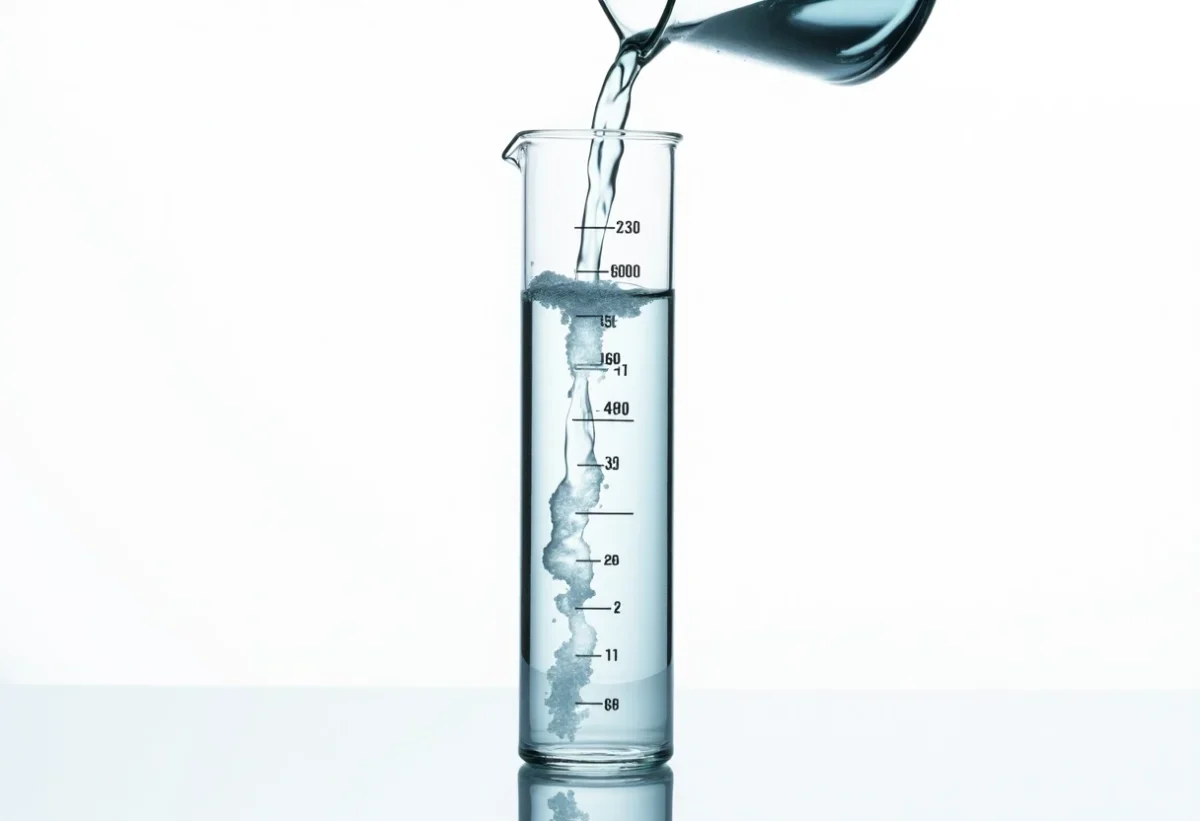
Understanding how to convert volumes is essential, especially in fields like cooking or science. For example, cooking often involves following recipes from different regions that use various measurements. Knowing how to convert milliliters to centiliters allows you to maintain the exact proportions, ensuring the success of your dishes.
Similarly, in laboratories, handling solutions requires great precision. Measuring instruments may display volumes in milliliters or centiliters. Knowing the conversion between these units ensures rigorous and reliable scientific experiments, avoiding any manipulation errors.
Understanding Measurement Units: Milliliters and Centiliters
Volume measurement units, such as milliliters (ml) and centiliters (cl), are ubiquitous in our daily lives. Whether in cooking, chemistry, or pharmacy, these units allow for precise measurement of liquids. One milliliter corresponds to one thousandth of a liter, while one centiliter represents one hundredth of a liter.
Equivalences and Conversions
To convert between milliliters and centiliters, you need to remember a few simple equivalences:
- 1 centiliter (cl) equals 10 milliliters (ml).
- 1 milliliter (ml) equals 0.1 centiliter (cl).
- 1 liter (L) equals 100 centiliters (cl) or 1000 milliliters (ml).
Let’s take a concrete example: if a recipe calls for 400 ml in centiliters, you simply divide by 10 to get 40 cl. This simplicity in conversions greatly facilitates the accuracy of measurements in various contexts.
Practical Applications
In cooking, recipes often use milliliters and centiliters to measure liquid ingredients such as water, milk, or wine. Similarly, in chemistry and pharmacy, these units are commonly used to prepare solutions or mixtures, requiring great rigor.
| Unit | Equivalence |
|---|---|
| 1 Liter (L) | 1000 Milliliters (ml) |
| 1 Centiliter (cl) | 10 Milliliters (ml) |
The understanding and mastery of these measurement units are therefore fundamental to ensure precision and success in operations requiring exact volumes.
Techniques and Tips for Converting Volumes
To successfully convert volumes between milliliters and centiliters, some tools and techniques are essential. Using a measuring cup graduated in milliliters and centiliters greatly facilitates this task. It allows for precise measurement of liquids, whether it is water, milk, or wine, all of which have a density close to 1 g/ml.
Conversion Rules
The conversion relies on simple rules:
- 1 centiliter (cl) = 10 milliliters (ml)
- 1 milliliter (ml) = 0.1 centiliter (cl)
In practice, to convert 250 ml to cl, simply divide 250 by 10, resulting in 25 cl. Conversely, to convert from 50 cl to ml, multiply 50 by 10, which gives 500 ml.
Practical Applications
In cooking, conversion is often necessary to adapt recipes. For example, if a recipe calls for 0.5 liters of milk, you can convert this volume to 50 cl or 500 ml depending on the available utensils. Similarly, a food scale can be used to measure liquids when the measuring cup is not available, based on the density of the liquids.
These techniques and tips allow for easy navigation between different measurement units, ensuring optimal precision in all situations.